Leadership is Harder than it looks
Your team members are wicked smart, driven, and creative, but getting them all pointed in the right direction at the same time? Not so easy.
This problem is compounded by the fact that traditional management approaches don’t work well with creative professionals. The people on your team were hired because of their independence, out-of-the-box thinking, passion, and drive. Forcing them to comply with rules they don’t understand, work on projects they had no say over, and follow rigid procedures is both exhausting and counterproductive.
And yet.
Having a team of people doing whatever they want, whenever they want, is inefficient. Plus, laissez-faire leadership doesn’t support true collaboration—the kind that allows great teams to produce next-level results.
The problem isn’t that your team won’t cooperate.
The problem is that most management approaches don’t address the system your team is operating inside.
Manage the process, not the people
Nonviolent Leadership is a systems-based leadership approach designed to shift a leader’s focus away from forcing people to do what you want toward creating an environment where everyone’s goals are aligned.
In addition to being far more humane, Nonviolent Leadership has a strategic benefit for your organization: it creates opportunities for your team to move faster, in the right direction, with less overall effort.
That’s a big claim, but the math backs it up.
Traditional management approaches assume successful leaders “make” their team do the work they are supposed to do.
The leader pushes the team; the team pushes the work.
When people are pushed, they resist.
Lead → Team → Work
But that formula ignores an important fact about human systems: When people are pushed, they resist. When leaders understand both where the organization is headed and what motivates the people doing the work, a new option emerges: design a work environment where those goals are compatible.
For leaders, that means shifting your focus away from directing the day-to-day behavior of your team members and toward creating and maintaining a system where force is no longer needed because people want to move in the same direction.
When you do that, the vectors change:
Lead → System
Team → Work
The challenge is that the system supporting your team’s output isn’t always obvious—even to experienced tech leaders. Most of us were trained to debug code, not human systems.
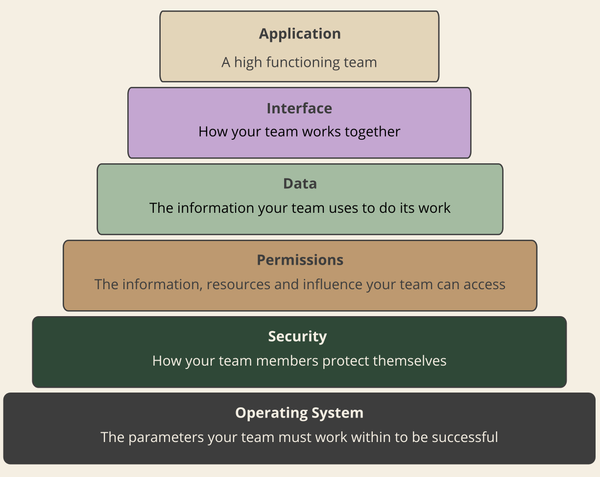
To help bridge that gap, I’ve developed a mental model that maps human systems to a system you already know: the tech stack.
Introducing the Leadership Stack
When a technical system breaks, you don’t just look for bugs in the application layer; you debug the whole stack.
The Leadership Stack applies that same idea to teams: it’s a way to reframe squishy human problems as system bugs.
How it works
Even though people problems show up in the application layer, debugging them there rarely works. At best it leads to short-term results. It also creates team friction that slows you down. At worst, it leads to disengagement, burnout, and a toxic team culture.
The Leadership Stack helps you find where the bug originated. Then you and your team can work together to solve the problem for good, instead of wasting your energy pushing against each other.

Leveraging the Leadership Stack
The Leadership Stack is a simple model, but applying it to real teams can be surprisingly hard—especially when you’re in the middle of the problem.
I share practical examples, breakdowns of real leadership situations, and tools for debugging human systems both here and on LinkedIn. If you want to go deeper, subscribers also get early access to workshops, coaching, and other ways to work with me directly.
Subscribe to dig deeper into the Leadership Stack and learn how to use it in the real world.